

 English
 中文简体
中文简体 Español
Content
- 1 The Core Components Inside a Hair Dryer
- 2 The Physics of Hair Drying: How Heat and Airflow Remove Moisture
- 3 High-Speed Hair Dryers vs. Traditional Hair Dryers: How They Differ
- 4 How Negative Ion Technology Works in Hair Dryers
- 5 Power Consumption and Wattage: What the Numbers Mean
- 6 Safety Features Built into Modern Hair Dryers
- 7 Best Practices for Using a Hair Dryer to Protect Hair Health
- 8 About Ningbo Youming Electrical Appliance Co., Ltd.
A hair dryer works by drawing in ambient air with an electric motor-driven fan, passing that air over a resistive heating element to raise its temperature, and then directing the heated airflow onto wet hair to evaporate moisture quickly. The combination of heat and moving air accelerates the natural evaporation process dramatically — reducing drying time from the 20 to 40 minutes of air-drying to just 2 to 10 minutes depending on hair thickness and dryer wattage. Modern hair dryers add further features including multiple heat and speed settings, cool-shot buttons, ionic technology to reduce frizz, and in high-speed models, brushless digital motors that deliver powerful airflow with less heat — protecting hair health while drying faster than traditional designs.
The Core Components Inside a Hair Dryer
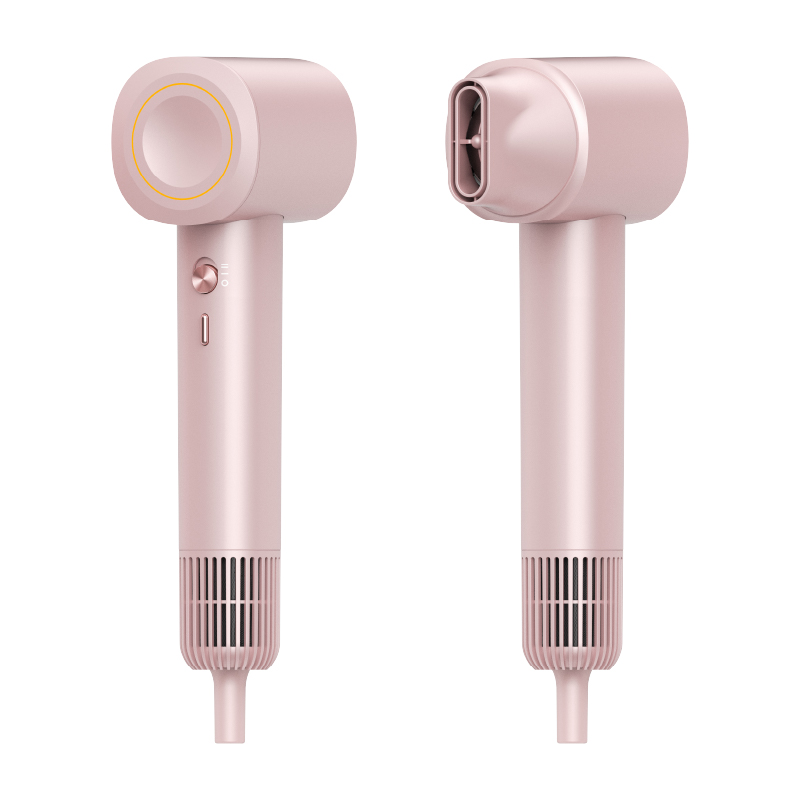
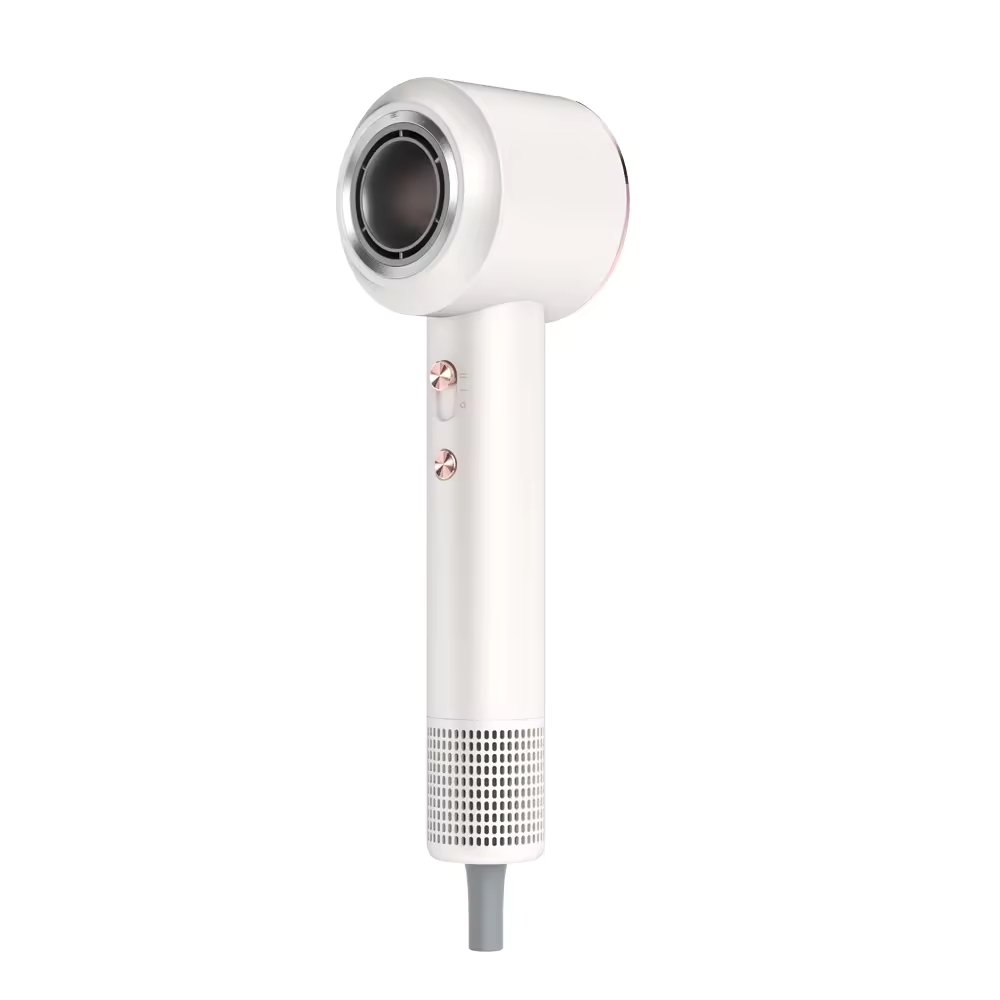
To understand how a hair dryer works, it helps to first understand what is inside one. Despite their compact size, hair dryers contain a carefully integrated set of components that work together as a system.
Electric Motor and Fan
At the heart of every hair dryer is an electric motor connected to a fan blade assembly. When power is applied, the motor spins the fan at high speed — typically 10,000 to 20,000 RPM in conventional models and up to 110,000 RPM in brushless high-speed digital motor models. The spinning fan creates a low-pressure zone at the intake (rear of the barrel) that draws ambient room air into the dryer, while the pressure differential pushes air through the barrel and out of the nozzle at the front.
Traditional hair dryers use universal AC motors — the same type used in vacuum cleaners and power tools — which are relatively inexpensive, compact, and powerful but generate significant heat themselves and produce a characteristic high-pitched noise. High-speed hair dryers use brushless DC digital motors, which are smaller, quieter, more energy-efficient, and capable of much higher rotational speeds, producing greater airflow volume at lower noise levels.
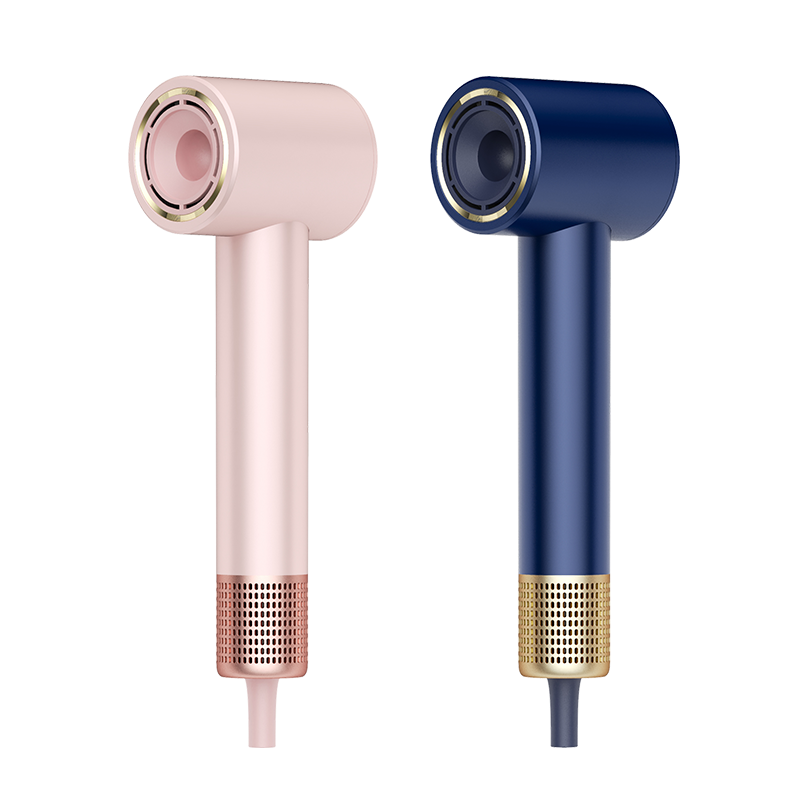
Heating Element
The heating element is a coil or grid of nichrome (nickel-chromium alloy) resistance wire stretched across the air path inside the barrel. Nichrome is chosen because it has high electrical resistance — meaning it converts electrical energy to heat efficiently — while also having a high melting point (approximately 1,400°C / 2,552°F) that makes it safe even at the high surface temperatures reached during operation.
As electric current flows through the nichrome wire, resistance heating raises the wire temperature to several hundred degrees Celsius. The air stream from the fan passes over and through this hot element, absorbing heat energy by convection and increasing the air temperature to the range used for drying — typically 60°C to 110°C (140°F to 230°F) at the nozzle outlet depending on the selected heat setting. Higher settings apply more power to the element; lower settings reduce the current, lowering the element temperature and consequently the outlet air temperature.
Thermal Cut-Out (Safety Thermostat)
Every hair dryer includes at least one thermal cut-out device — a bimetallic strip or thermal fuse — positioned in the air path near the heating element. If the air flow is blocked (for example, if the rear intake grille is covered by hair or a towel) and the internal temperature rises above a preset safety threshold (typically 95°C to 120°C), the thermal cut-out interrupts power to the heating element automatically. This prevents the nichrome wire from reaching temperatures that could ignite internal plastic components or cause burns. In most designs, the thermal cut-out is self-resetting — it reconnects the heating circuit automatically once the temperature drops back to a safe level.
Selector Switches
The switches on the handle control the heat and speed settings by routing electrical current through different combinations of heating element sections and motor speed control circuits:
- High heat: Full power to both heating element sections. Outlet temperature typically 95°C to 110°C.
- Low heat: Power to only one section of the heating element, reducing outlet temperature to 60°C to 80°C.
- High speed: Full motor voltage, maximum fan RPM and airflow volume.
- Low speed: Reduced motor voltage via a series resistor, lower RPM and gentler airflow.
- Cool shot: A momentary switch that bypasses the heating element entirely, directing an unheated airflow to cool and set the hair style.
Ionic Generator
Many modern hair dryers incorporate an ionic generator — a small high-voltage circuit connected to a tourmaline or ceramic-coated element that produces negative ions (negatively charged particles). These negative ions interact with the positively charged water molecules on the hair shaft, breaking large water droplets into smaller ones that evaporate more quickly. They also neutralize the positive static charge that builds up on dry hair, reducing frizz, increasing smoothness, and preserving the hair's natural moisture balance. This is particularly beneficial for chemically treated, color-treated, or naturally dry hair types.
Concentrator Nozzle and Diffuser Attachments
The airflow leaving the barrel can be modified by attachments that change the velocity, direction, and distribution of the air:
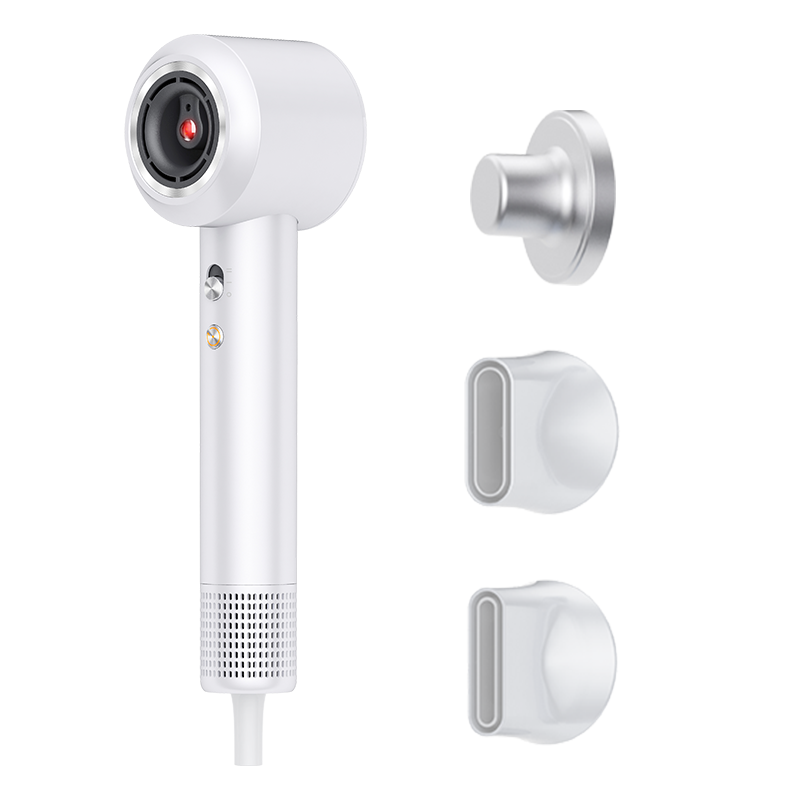
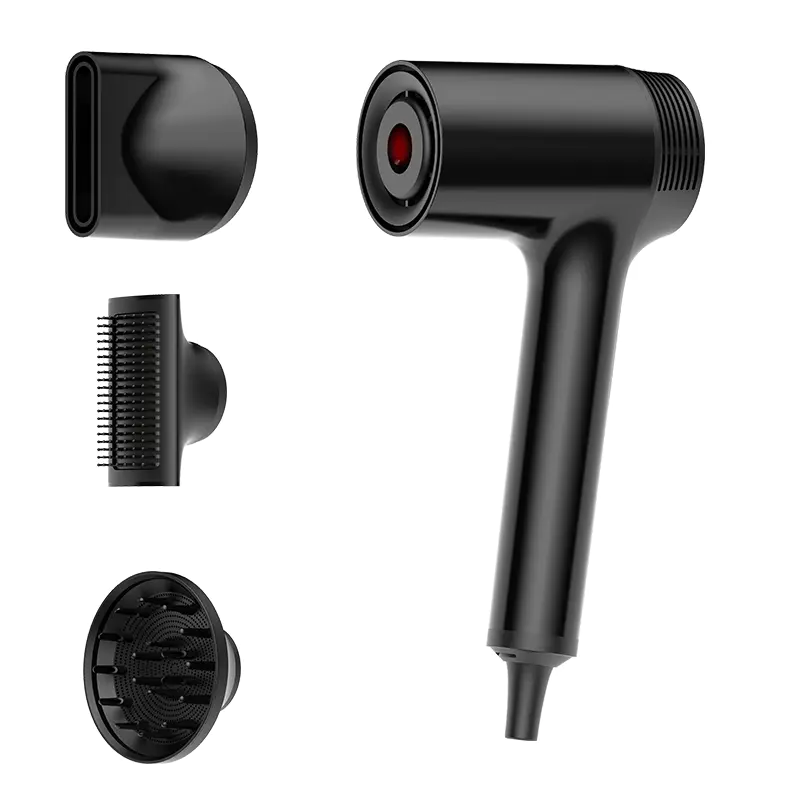
- Concentrator nozzle: A flat, narrow attachment that focuses the airflow into a directed stream. Used for precise straightening and smoothing — directing hot air along the hair shaft while brushing to create a sleek finish.
- Diffuser attachment: A wide, bowl-shaped attachment with multiple prongs that spreads the airflow over a large area with reduced velocity. Ideal for curly or wavy hair — preserving the natural curl pattern by drying hair gently without disrupting curl formation with a strong direct airstream.
The Physics of Hair Drying: How Heat and Airflow Remove Moisture
Hair drying is fundamentally an evaporation process. Water on and within the hair shaft must be converted from liquid to vapor and carried away from the surface. Two physical mechanisms drive this:
Temperature and Evaporation Rate
Evaporation rate is directly related to temperature. At room temperature (20°C / 68°F), water evaporates slowly because few water molecules have enough kinetic energy to escape from the liquid surface into the air. Increasing the air temperature to 80°C to 100°C gives a much larger proportion of water molecules sufficient energy to evaporate — increasing the evaporation rate by a factor of 5 to 10 times compared to still room air. This is why a hair dryer dries hair so much faster than air-drying.
Airflow and Boundary Layer Removal
Even at elevated temperatures, evaporation slows significantly once the air immediately surrounding the wet hair becomes saturated with water vapor — creating what physicists call a saturated boundary layer. The moving airflow from the dryer's fan continuously sweeps this saturated air away from the hair surface, replacing it with drier air that can absorb more moisture. This convective effect is why airflow speed matters as much as temperature for drying speed. A high-speed hair dryer leverages this principle by maximizing airflow volume, allowing faster drying even at lower temperatures — which is healthier for hair structure.
What Happens to the Hair Structure During Drying
Each hair strand is composed of an inner cortex of keratin protein fibers surrounded by a protective outer cuticle layer of overlapping scales. When hair is wet, the cuticle scales are raised and the keratin bonds within the cortex are relaxed, making the hair pliable and temporarily re-shapeable. As heat and airflow remove moisture and the hair dries, the hydrogen bonds within the keratin cortex reform, locking the hair into whatever shape it has been styled into during drying. This is the physical basis for blow-drying styles — heat sets the shape, and the cool-shot button locks it in by rapidly cooling the hair while the new bonds are still forming.
Excessive heat (above approximately 150°C / 302°F at the hair surface) begins to damage the cuticle, causing the scales to crack and lift permanently, leading to the dull, frizzy, brittle appearance of heat-damaged hair. This is the central reason why controlling outlet temperature, using heat protection products, and maintaining adequate distance from the hair (typically at least 15 cm / 6 inches) are important best practices.
High-Speed Hair Dryers vs. Traditional Hair Dryers: How They Differ
High-speed hair dryers represent a significant evolution in drying technology. Rather than relying primarily on high temperatures to evaporate moisture, they leverage powerful, high-volume airflow generated by brushless digital motors to achieve faster drying at lower, safer temperatures. Understanding the differences helps users choose the right type for their hair needs.
| Feature | Traditional Hair Dryer | High-Speed Hair Dryer |
|---|---|---|
| Motor Type | Universal AC motor | Brushless digital DC motor |
| Motor Speed | 10,000 – 20,000 RPM | Up to 110,000 RPM |
| Primary Drying Mechanism | High temperature heat | High-volume airflow + moderate heat |
| Typical Outlet Temperature | 80°C – 110°C (176°F – 230°F) | 55°C – 80°C (131°F – 176°F) |
| Weight | 400 – 700 g | 300 – 450 g (lighter motor) |
| Noise Level | 75 – 90 dB | 60 – 75 dB |
| Hair Health Impact | Higher heat damage risk | Lower heat damage; better moisture retention |
| Ionic Output | Available in some models | Standard in most high-speed models |
| Motor Lifespan | 200 – 600 hours typical | 600 – 1,000+ hours typical |
The key principle behind high-speed hair dryers is that powerful airflow can compensate for lower temperature in terms of drying speed, while the lower thermal exposure is far gentler on hair structure. The scalp and hair follicles are also better protected — high temperatures applied close to the scalp can cause discomfort, micro-inflammation of follicles, and accelerated scalp moisture loss. By drying with airflow rather than extreme heat, high-speed dryers reduce these risks significantly.
How Negative Ion Technology Works in Hair Dryers
Ionic hair dryers are now a standard feature in the mid-range and premium market. Understanding the mechanism behind negative ion output explains why it benefits hair condition during drying.
The Science of Ions and Water
Water molecules (H2O) have a slight positive polarity. When water sits on hair as large droplets or a film, it does so because surface tension keeps it in a coherent mass. Negative ions — produced by the hair dryer's ionic generator at concentrations of millions of ions per cubic centimeter — carry a negative charge that is attracted to these positively charged water clusters. The interaction breaks the surface tension of the large water droplets, dispersing them into a fine mist of microscopic droplets with a much greater combined surface area.
This dramatically increased surface area means the water evaporates much more quickly — reducing drying time by an estimated 20% to 40% compared to a non-ionic dryer operating at the same temperature and airflow settings. Because faster evaporation means less cumulative heat exposure, ionic technology indirectly reduces heat damage even without lowering the set temperature.
Frizz Reduction and Moisture Sealing
Frizz occurs when individual hair strands carry a static positive charge, causing them to repel each other and stand away from the main mass of hair. Negative ions neutralize this surface charge, causing strands to lie flat and smooth against each other. The result is visibly reduced frizz, increased shine, and a smoother cuticle surface that reflects light more uniformly.
Negative ions also help seal moisture within the hair shaft. By flattening the cuticle scales and promoting a tighter surface structure, ionic output helps the hair retain its natural moisture — preventing the over-dried, brittle texture that conventional high-heat drying can produce. This benefit is most noticeable in dry, color-treated, or chemically processed hair types where the cuticle is already compromised.
Power Consumption and Wattage: What the Numbers Mean
Hair dryer wattage is often the first specification consumers notice, but understanding what it actually represents helps set realistic expectations about drying performance.
Wattage represents total electrical power consumption, which is divided between the motor and the heating element:
- Motor power: Typically 50 to 150W in conventional models, and 30 to 100W in high-speed brushless motor models (which are more efficient despite producing more airflow).
- Heating element power: The dominant power consumer, typically 1,500 to 2,200W in household models operating on standard AC mains voltage.
A 2,200W dryer does not dry hair faster than a 1,800W dryer simply because of higher wattage — what matters is how efficiently that power is converted into effective drying (airflow velocity, temperature distribution, and ionic output). High-speed hair dryers with brushless motors may achieve equivalent or faster drying times at 1,200 to 1,600W compared to a conventional 2,000W+ model, because more of the energy goes into producing airflow rather than heat, and the airflow is used more effectively.
| Wattage Range | Typical Use Case | Approximate Drying Time (Medium Hair) | Notes |
|---|---|---|---|
| 800 – 1,200W | Travel, occasional use | 10 – 15 minutes | Dual voltage models available for international travel |
| 1,400 – 1,800W | Daily home use | 5 – 10 minutes | Most common household category |
| 2,000 – 2,400W | Thick / long hair, salon use | 3 – 7 minutes | Higher heat output; use with heat protectant |
| 1,200 – 1,600W (high-speed brushless) | Health-conscious / fine hair | 3 – 6 minutes | Lower temperature, high airflow; gentler on hair |
Safety Features Built into Modern Hair Dryers
Hair dryers combine electricity with water-adjacent use, making safety engineering a critical design requirement. Modern hair dryers incorporate multiple layers of protection:
- Thermal cut-out: Shuts off the heating element if internal temperatures exceed safe limits due to blocked airflow. Described in detail above.
- GFCI (Ground Fault Circuit Interrupter) plug: Required by electrical codes in many countries for bathroom appliances. The GFCI plug detects any leakage of current to ground (which would occur if the dryer fell into water) and cuts power within 1/40th of a second — fast enough to prevent electrocution.
- Intake grille: The rear grille prevents hair, fibers, and foreign objects from being drawn into the fan and heating element. Keeping this grille clean is important — lint buildup reduces airflow and can cause overheating.
- Hanging loop: A loop at the end of the handle allows the dryer to be hung rather than laid on a surface while hot, reducing the risk of contact with flammable materials.
- Cool-touch barrel: Modern dryers use plastic barrel materials with low thermal conductivity and maintain airflow through the barrel after shutdown to dissipate residual heat, reducing the risk of burns when the dryer is set down or stored immediately after use.
Best Practices for Using a Hair Dryer to Protect Hair Health
Understanding how a hair dryer works informs better technique. These evidence-based practices minimize heat damage while maximizing drying efficiency:
- Towel-dry before using the dryer: Removing as much surface water as possible with a towel (or a microfiber towel which absorbs more without friction damage) before using the dryer reduces the total heat exposure time needed.
- Apply heat protectant: A thermal protectant spray or serum forms a temporary barrier on the hair cuticle that distributes heat more evenly and raises the safe temperature threshold for the cuticle surface.
- Maintain distance: Keep the nozzle at least 15 cm (6 inches) from the hair. At this distance, air temperature at the hair surface is significantly lower than at the nozzle outlet, reducing the risk of exceeding the hair's safe heat threshold.
- Keep the dryer moving: Never hold the dryer stationary over one section of hair. Continuous movement distributes heat evenly and prevents localized overheating.
- Dry in sections: Dividing the hair into sections and drying each section fully before moving to the next is more efficient than repeatedly passing the dryer over all the hair at once.
- Use the cool-shot to set: After styling each section, use the cool-shot button for 5 to 10 seconds. Cooling the hair while the keratin bonds are still forming from the heat-styling process sets the style and improves longevity.
- Clean the intake grille regularly: Lint and debris buildup on the rear intake grille reduces airflow efficiency and can trigger the thermal cutout. Clean with a soft brush or compressed air every few weeks with regular use.
About Ningbo Youming Electrical Appliance Co., Ltd.
Ningbo Youming Electrical Appliance Co., Ltd. is a professional OEM hair dryer supplier and ODM blow dryer factory located in Ningbo, Zhejiang, China. The company operates from a facility covering more than 70,000 square meters and holds national High-tech Enterprise certification — reflecting its commitment to innovation-led manufacturing.
Since 2010, Youming has developed more than 100 home appliance products, spanning heaters, hair dryers, air purifiers, air circulators, humidifiers, and personal care products. Through an in-house design and development team, the company functions as a professional manufacturer of healthy home appliance products — combining advanced manufacturing capability with deep product knowledge to serve global customers through both OEM and ODM partnerships.
Youming's hair dryer product line includes both traditional and high-speed brushless motor models with negative ion output, designed to protect hair and scalp health while delivering efficient, powerful drying performance. The company's integrated R&D, tooling, and manufacturing capabilities enable customized product development that meets the diverse and evolving needs of international markets.
 Previous

 +86-574-63982198
 +86-574-63982197
 No. 933, Lingxu 2nd Road, Binhai Economic Development Zone, Cixi, Zhejiang, China.