

 English
 中文简体
中文简体 Español
Content
- 1 Why Choosing the Right Hair Dryer Matters for Hair Health
- 2 Wattage and Airflow: The Foundation of Drying Performance
- 3 Heat Settings and Temperature Control
- 4 Ionic Technology: What It Does and When You Need It
- 5 Infrared Technology: Drying from the Inside Out
- 6 Weight, Ergonomics, and Cord Length
- 7 Attachments: Concentrators, Diffusers, and Styling Nozzles
- 8 Safety Certifications and Overheat Protection
- 9 Comparing Hair Dryer Types: A Practical Selection Guide
- 10 Special Considerations by Hair Type
- 11 Noise Level: An Underrated Selection Factor
- 12 Travel Considerations: Dual Voltage and Compact Design
- 13 Using Your Hair Dryer Correctly to Protect Hair Health
- 14 Final Checklist: What to Confirm Before Purchasing
To choose a good hair dryer, focus on five core factors: wattage and airflow power for your hair type, motor technology for longevity and noise level, heat and speed settings for styling flexibility, hair-protective technologies such as ionic or infrared functions, and safety certifications that confirm electrical reliability. A wattage of 1,800 to 2,400 watts covers the needs of most hair types; fine or thin hair benefits from lower wattage and ionic technology to minimize frizz and static, while thick, coarse, or very long hair needs higher airflow output to reduce drying time. Beyond these technical specifications, ergonomics, cord length, weight, and available attachments all determine how comfortable and practical the dryer will be in daily use. This guide walks through every selection criterion in detail so you can make a confident, informed choice rather than guessing based on marketing claims.
Why Choosing the Right Hair Dryer Matters for Hair Health
A hair dryer is one of the most frequently used personal care tools in most households, and using an unsuitable one consistently — whether too hot, too powerful for the hair type, or lacking protective technology — contributes measurably to hair damage over time. Studies on thermal hair damage have found that sustained exposure to heat above 175 degrees Celsius begins to degrade the disulfide bonds and alpha-keratin structure that give hair its strength and elasticity, and that daily high-heat drying without adequate moisture protection accelerates this degradation significantly (Source: Evans, T. et al., "The Effect of Heat Treatments on the Mechanical Properties of Hair," Journal of Cosmetic Science, Vol. 57, 2006).
Conversely, a correctly chosen hair dryer with appropriate temperature settings, ionic technology, and a well-designed airflow path can dry hair faster than air drying, reduce the total heat exposure time required, and leave hair smoother, shinier, and less frizzy than it would be after natural drying — particularly in humid environments. The key is matching the dryer's capabilities to the specific needs of your hair type and styling routine.
Wattage and Airflow: The Foundation of Drying Performance
Wattage is the most commonly cited specification on hair dryer packaging, but it is important to understand what wattage actually measures and how it translates into real-world drying performance.
What Wattage Tells You
Wattage measures the total electrical power consumed by the dryer — including both the heating element and the motor that drives the fan. A dryer with higher wattage can produce more heat energy and more airflow, but these two outputs are generated by different components. A poorly designed high-wattage dryer may produce a lot of heat but insufficient airflow to carry it effectively to the hair surface, resulting in slow drying and uneven heating. A well-engineered dryer balances heat output and airflow volume to maximize drying efficiency at any given wattage.
As a practical guide for wattage selection by hair type:
- Fine or thin hair: 1,400 to 1,600 watts is typically sufficient; excess power dries fine hair too quickly with less temperature control, increasing the risk of heat damage
- Normal or medium-density hair: 1,600 to 1,800 watts provides comfortable drying time without excess heat exposure
- Thick, coarse, or very long hair: 1,800 to 2,400 watts reduces the total drying time significantly, decreasing cumulative heat exposure compared to a lower-wattage dryer that needs to stay on longer to achieve the same result
- Professional or salon use: 2,000 to 2,400 watts allows fast, efficient drying across all hair types throughout a busy working day
Motor Technology and Airflow Quality
The motor inside a hair dryer determines the volume and velocity of air it can move, how much noise it generates during operation, and how long it will last before performance degrades. Two main motor technologies are used in hair dryers:
- AC (alternating current) motors: The traditional choice for professional and high-quality consumer dryers, AC motors are typically more powerful, longer-lasting, and capable of sustained high-speed operation. A quality AC motor dryer has a service life of 800 to 1,000 hours, compared to 300 to 400 hours for most DC motor alternatives (Source: IEC 60335-2-23, Household and Similar Electrical Appliances — Safety for Appliances for Skin and Hair Care)
- DC (direct current) motors: DC motors are lighter and less expensive to manufacture, making them the standard choice for entry-level and mid-range consumer dryers. They are adequate for moderate-frequency home use but may show performance degradation more quickly in daily high-volume use
- High-speed digital motors: A newer category of brushless DC digital motors operating at very high RPM (typically 100,000 to 110,000 RPM compared to 10,000 to 20,000 RPM for conventional motors) produces exceptional airflow volume at significantly lower noise levels and reduced weight. These motors are featured in premium hair dryer products and represent a meaningful performance upgrade over conventional motor designs
Heat Settings and Temperature Control
Temperature control is one of the most important features for hair health, and the number and range of heat settings available determines how precisely you can match drying temperature to your hair's specific needs and condition on any given day.
Why Multiple Heat Settings Matter
Most quality hair dryers offer three heat settings (low, medium, high) plus a cool shot button. The cool shot function — a burst of unheated air — is not a minor convenience feature; it is the mechanism for setting a style and locking cuticle scales closed after styling, which significantly improves shine and reduces frizz in the finished result. A dryer without a cool shot button is missing a functionally important capability.
Heat setting ranges across the three levels typically span approximately 50 to 230 degrees Celsius in most quality consumer dryers, though the actual temperature at the hair surface depends on the distance from the nozzle, the airflow volume, and ambient conditions. Hair care professionals generally recommend staying below 180 degrees Celsius for daily drying to minimize cumulative heat damage, particularly for color-treated, chemically processed, or fine hair (Source: Gavazzoni Dias, M.F.R., "Hair Cosmetics: An Overview," International Journal of Trichology, Vol. 7, Issue 1, 2015).
Thermostatic vs. Non-Thermostatic Temperature Control
Budget hair dryers use simple resistance-based heating elements with no active temperature monitoring — the heating element produces a fixed output at each setting regardless of ambient temperature, airflow restriction, or operating duration. Quality dryers incorporate thermostatic sensors that monitor the actual air temperature at the outlet and adjust the heating element power to maintain the selected temperature consistently, even when the dryer has been running for an extended period or when airflow is partially restricted by a styling attachment. Thermostatic control provides safer, more predictable heat output and is a mark of quality construction worth looking for in a purchase.
Ionic Technology: What It Does and When You Need It
Ionic hair dryers are one of the most widely marketed claims in the hair dryer category, and understanding what ionic technology actually does allows you to assess whether it is genuinely relevant to your hair type or primarily a marketing addition.
Ionic dryers incorporate a component — typically a tourmaline-coated surface or a negative ion generator — that produces negative ions in the airstream. These negatively charged ions interact with positively charged water molecules on the hair surface, breaking them into smaller particles that evaporate more quickly. The result is faster drying at lower temperatures, reduced static electricity buildup, and smoother, less frizzy hair after drying — particularly noticeable in medium to coarse hair types and in humid environments.
Hair Types That Benefit Most from Ionic Technology
- Frizzy or curly hair: Negative ions close the cuticle scales that create frizz, producing smoother results with less heat
- Thick or coarse hair: The faster moisture breakdown accelerates drying of dense hair without requiring sustained maximum heat
- Hair in humid climates: Ionic technology is particularly effective at counteracting the humidity-induced frizz that is difficult to control with conventional dryers
- Color-treated or chemically processed hair: The ability to dry effectively at lower temperatures reduces cumulative heat stress on hair that is already structurally compromised
When Ionic Technology Is Less Important
For very fine, straight hair, strong ionic output can occasionally produce a result that is too flat or lacks the volume that the hair's natural texture provides. Users with very fine, naturally straight hair may find that a conventional or lightly ionic dryer gives better volume than a strong ionic output. This is not a flaw in the technology but a reflection of how it interacts with specific hair characteristics.
Infrared Technology: Drying from the Inside Out
Infrared hair dryers use infrared wavelength energy to heat the water molecules within the hair shaft itself rather than heating the outer surface of the hair first and waiting for heat to conduct inward. This inside-out heating mechanism produces several practical benefits:
- Faster overall drying: Heating from within reduces the total energy required to evaporate moisture from the hair shaft, shortening drying time
- More even heat distribution: Conventional hot airflow creates a temperature gradient from the outer hair surface inward; infrared heating is more uniform throughout the hair's cross-section
- Reduced surface overheating: Because the target is internal moisture rather than surface temperature, infrared dryers can achieve faster drying without exposing the outer cuticle layer to the same peak temperatures that conventional dryers use
- Improved moisture retention: Studies comparing conventional and infrared drying have found that infrared-dried hair retains significantly more of its natural moisture content, resulting in less post-drying brittleness and improved elasticity (Source: Lee, Y. et al., "Hair Damage from a Repetition of Entire Bleaching and Successive Dyeing with Various Hair Dyes," International Journal of Trichology, 2012)
Infrared technology is typically found in professional-grade and premium consumer dryers rather than entry-level products, and it is often combined with ionic technology for a combined approach to heat-efficient, hair-protective drying.
Weight, Ergonomics, and Cord Length
The physical usability of a hair dryer affects how tiring it is to use during a long drying and styling session and how practical it is to travel with or store. These factors are frequently underweighted in purchasing decisions made purely on specification comparison but become highly significant in daily use.
Weight and Balance
Professional stylists who use a hair dryer for multiple hours per day consistently cite weight as a primary factor in equipment satisfaction and arm fatigue. Most conventional consumer hair dryers weigh between 500 and 800 grams. Premium dryers featuring high-speed digital motors can weigh as little as 350 to 450 grams — a reduction of 30 to 40% that becomes very noticeable over a 15-to-20-minute drying and styling session.
Balance point matters as much as absolute weight. A dryer where most of the weight is concentrated at the back of the handle near the cord entry requires less wrist effort to hold than one where weight is concentrated at the nozzle end. Test the balance of any dryer you are seriously considering — if possible, hold it in the grip position for 30 seconds to feel how the weight distributes in actual use.
Handle Grip and Ergonomic Design
Handle diameter, surface texture, and the placement of the speed and heat control buttons all affect how comfortably and intuitively the dryer can be operated. Controls that require you to look at the dryer to find the right button interrupt the natural process of watching your hair in the mirror while styling. Quality dryers position their most-used controls — typically the speed switch and the cool shot button — in positions that can be operated by feel without visual reference.
Cord Length
A cord of at least 1.8 to 2.5 metres is recommended for comfortable use at a bathroom mirror where the power outlet may be some distance from the mirror surface. Shorter cords force the user to stand uncomfortably close to the outlet or adopt awkward wrist angles, both of which make controlled styling more difficult. Professional salon dryers typically use 3-metre cords to provide freedom of movement during client service. For travel, a dryer with a folding handle and a cord that tucks neatly into the storage case is a practical advantage.
Attachments: Concentrators, Diffusers, and Styling Nozzles
The attachments included with a hair dryer — and how well they fit and perform — significantly affect the dryer's versatility for different styling needs. Many consumers buy a dryer and never use any attachment beyond the basic concentrator, but those with curly or wavy hair may find a diffuser attachment more valuable than any other specification of the dryer body itself.
Concentrator Nozzle
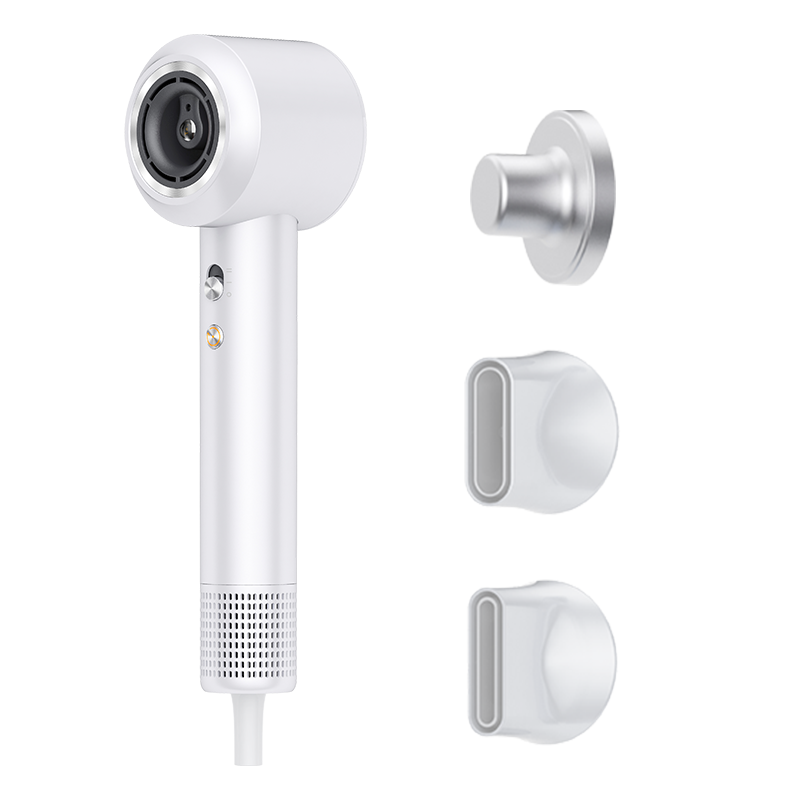
The concentrator is the standard flat, elongated nozzle that focuses the airstream into a narrower, more directed flow. It is used for precision blow-drying, smoothing specific sections of hair, and directing airflow along the hair shaft from root to tip — the direction that aligns the cuticle scales and produces the maximum smoothness and shine in the finished result. A well-designed concentrator fits snugly without wobble and is easy to remove without burning fingers on the heated metal barrel.
Diffuser Attachment
A diffuser is a wide, bowl-shaped attachment with multiple prongs or pins that disperses the airstream over a large area at reduced velocity. This low-speed, dispersed airflow dries curly and wavy hair without disrupting the natural curl pattern — the primary challenge in drying curly hair, where direct high-velocity airflow from a standard nozzle separates curls and causes frizz. For curly hair users, a diffuser attachment transforms the drying experience, and any dryer being considered for curly hair should be evaluated on the quality and compatibility of its diffuser.
Comb and Styling Nozzles
Some dryers include comb attachments for straightening and separating while drying, and narrow styling nozzles for more precise directional control than the standard concentrator. These are useful for specific styling needs but are not essential for most users — their value depends on the styling routines of the individual.
Safety Certifications and Overheat Protection
Hair dryers are used in bathrooms where water and electricity are in close proximity, making safety certifications more than a bureaucratic formality — they are practical indicators of the engineering choices made to protect the user during daily use.
Key Safety Features to Look For
- Thermal cut-out (overheat protection): A thermal fuse or resettable thermostat that disconnects the heating element if the outlet temperature exceeds a safe threshold — essential protection if the air inlet is accidentally blocked
- ALCI (Appliance Leakage Current Interrupter) plug: Required on hair dryers sold for use in North American bathroom environments; detects current leakage to ground and disconnects within milliseconds, preventing electrocution if the dryer contacts water
- GFCI (Ground Fault Circuit Interrupter) compatibility: Ensures the dryer will function correctly and safely on circuits protected by GFCI outlets, which are required by electrical codes in bathroom locations in many jurisdictions
- CE marking (European Union): Confirms compliance with applicable EU product safety directives including the Low Voltage Directive (LVD) and the Electromagnetic Compatibility (EMC) Directive
- UL Listing (United States and Canada): Independent safety certification confirming the product has been tested to applicable safety standards by Underwriters Laboratories
- Filter protection: Inlet air filters that prevent hair, dust, and debris from entering the motor housing; these must be accessible for cleaning to maintain airflow and prevent overheating from filter blockage
Voltage Compatibility for International Use
If you use your hair dryer when traveling internationally, confirm whether it supports dual voltage (typically labeled 100-240V, 50/60Hz). Hair dryers designed only for single-voltage operation (110V or 220V) will be damaged or perform poorly if used in a country with a different mains voltage, even with a physical plug adapter. A dual-voltage dryer with a physical plug adapter is the correct approach for international travel, rather than using a voltage converter with a single-voltage dryer.
Comparing Hair Dryer Types: A Practical Selection Guide
The market for hair dryers spans a wide range from basic value-tier products to advanced professional-specification designs. The following comparison helps clarify which category is the right starting point for different user needs:
| Type | Wattage Range | Motor Type | Key Technologies | Best For |
|---|---|---|---|---|
| Entry-level consumer | 1,200 to 1,600 W | DC motor | Basic heat and speed settings | Occasional use, travel, fine hair |
| Mid-range ionic consumer | 1,600 to 1,800 W | DC motor | Ionic, concentrator and diffuser included | Daily use, most hair types |
| Premium consumer | 1,800 to 2,200 W | AC or high-speed DC | Ionic, infrared, multiple settings, thermostatic | Thick or curly hair, frequent use, quality-focused buyers |
| High-speed digital motor | 1,400 to 1,600 W (equivalent output to 2,200 W conventional) | Brushless digital motor (100,000+ RPM) | Ionic, very lightweight, low noise | Users prioritizing weight, noise, and speed; all hair types |
| Professional salon | 2,000 to 2,400 W | AC motor | Ionic, infrared, high durability, long cord | Salon professionals, frequent high-volume use |
| General category comparison for hair dryer types; specific product specifications vary by manufacturer and model within each category | ||||
Special Considerations by Hair Type
The specifications that matter most in a hair dryer shift depending on the specific characteristics of your hair. The following guidance addresses the most common hair types and their specific dryer requirements.
Fine or Thin Hair
Fine hair dries quickly but is easily damaged by excessive heat, and is prone to static and flyaways with conventional dryers. Key specifications: moderate wattage (1,400 to 1,600 W), ionic technology to control static and add shine, a concentrator nozzle for volume-building techniques, and a cool shot function to set volume at the root before the hair cools and falls flat. Avoid the highest heat setting for daily use — fine hair reaches damaging temperatures faster than thick hair.
Thick or Coarse Hair
Thick or coarse hair has the highest thermal mass of any hair type and requires sustained high-volume airflow to dry in reasonable time. Using a low-wattage dryer on thick hair results in prolonged heat exposure — the opposite of what is intended for hair health. Key specifications: high wattage (1,800 to 2,400 W), strong airflow with multiple speed settings, ionic technology for smoothing, and a well-designed concentrator for section-by-section work. A dryer with thermostatic temperature control prevents overheating during the extended drying sessions that thick hair requires.
Curly or Wavy Hair
Curly and wavy hair requires the most thoughtful approach to dryer selection because the airflow characteristics matter as much as heat output. High-velocity direct airflow causes curl disruption and frizz; dispersed low-velocity airflow preserves curl pattern. Key specifications: a quality diffuser attachment is non-negotiable, ionic technology for frizz control, a lower-speed setting option for diffusing, and infrared technology where available to minimize surface frizz while drying from within the hair shaft.
Color-Treated or Chemically Processed Hair
Color-treated, bleached, relaxed, or permed hair has a structurally compromised cuticle layer that is more vulnerable to heat damage than virgin hair. Key specifications: ionic technology for gentle, efficient drying at lower temperatures, thermostatic temperature control to prevent accidental overheating, and infrared technology where available. The highest heat setting should be avoided for daily use on chemically processed hair — using medium heat with multiple passes is significantly less damaging than using maximum heat with a single pass.
Noise Level: An Underrated Selection Factor
Hair dryer noise is rarely listed as a headline specification but is a practical quality-of-life consideration that many users identify as a significant daily irritation after purchase. Conventional AC motor dryers typically operate at 85 to 95 decibels at normal use distance — comparable to a lawnmower or motorcycle at close range, and well above the 70 dB threshold identified by the World Health Organization as the maximum level for prolonged exposure without hearing risk (Source: WHO, Environmental Noise Guidelines for the European Region, 2018).
High-speed digital motor dryers operate at a higher fundamental frequency that many users perceive as less intrusive than the lower-frequency noise of conventional motors, and some designs achieve noise levels of 70 to 75 dB — a reduction that is perceived as roughly half as loud due to the logarithmic nature of the decibel scale. For users who dry their hair in shared living spaces early in the morning, or who dry a young child's hair, noise level is a meaningful selection criterion worth investigating before purchase.
Travel Considerations: Dual Voltage and Compact Design
For frequent travelers, hair dryer selection involves additional criteria beyond performance and hair health. A dryer that performs perfectly at home but cannot be used safely abroad — or that is too bulky to fit conveniently in a travel bag — becomes a source of frustration on every trip.
- Dual voltage: Look for a dryer labeled 100-240V and 50/60Hz; this indicates it can be used on both North American 110-120V mains and European/Asian 220-240V mains with only a physical plug adapter
- Folding handle: A folding handle reduces the packed length of the dryer substantially, making it easier to fit in a carry-on bag without wasted space
- Weight under 400 grams: Lighter dryers are more practical for travel without sacrificing luggage weight allowance
- Included storage pouch: A heat-resistant storage pouch that the dryer can be packed into while still warm is a practical convenience for busy travel routines
Using Your Hair Dryer Correctly to Protect Hair Health
Even the best hair dryer can damage hair if used incorrectly, and even a basic dryer will cause minimal damage if best practices are consistently followed. The following techniques apply regardless of which dryer you choose.
- Towel dry first to reduce moisture load: Removing excess surface water by gently pressing (not rubbing) with a microfiber towel before using the dryer reduces the total drying time needed and therefore the cumulative heat exposure. Start drying with approximately 60 to 70% of moisture already removed by towel drying
- Apply heat protectant to damp hair: A heat protectant serum or spray applied to damp hair before blow-drying forms a protective film over the cuticle that reduces the peak temperature the hair surface reaches under the dryer's airflow
- Keep the dryer moving: Holding the dryer in a fixed position over the same section of hair concentrates heat and accelerates damage; keep the dryer moving continuously along each section
- Maintain at least 15 cm distance: Holding the dryer closer than 15 cm from the hair significantly increases the surface temperature at the hair; most damage from hair dryer use occurs in the final 10 cm of distance, where temperature rises sharply
- Direct airflow downward along the hair shaft: Drying with the airflow directed from roots toward tips aligns the cuticle scales in their natural closed position, maximizing shine and reducing frizz compared to drying against the cuticle direction
- Finish with a cool shot: Switching to the cool setting for the final 30 seconds of drying seals the cuticle, sets the style, and immediately reduces the residual heat in the hair, stopping further thermal processing
Final Checklist: What to Confirm Before Purchasing
Whether you are choosing a hair dryer for personal daily use, for professional salon work, or as a gift, the following checklist provides a structured final review of the key selection criteria covered throughout this guide:
- Wattage is appropriate for your hair type — 1,400 to 1,600 W for fine hair; 1,800 to 2,400 W for thick or coarse hair
- Motor type matches your use frequency — AC or digital motor for daily use; DC motor adequate for occasional use
- Multiple heat and speed settings are available — at minimum low, medium, and high heat, plus a cool shot button
- Ionic technology is present if frizz control, static reduction, or faster drying at lower temperatures is a priority for your hair type
- A quality concentrator nozzle is included — and a diffuser if you have curly or wavy hair
- Safety certifications are confirmed — CE, UL, ALCI plug, thermal cut-out protection
- Weight and cord length suit your use context — lighter for frequent long sessions or professional use; longer cord for bathroom use away from outlets
- Dual voltage is present if you travel internationally
- Noise level is acceptable for your home environment and household routine
 Previous

 +86-574-63982198
 +86-574-63982197
 No. 933, Lingxu 2nd Road, Binhai Economic Development Zone, Cixi, Zhejiang, China.