

 English
 中文简体
 Español

Content
The result people want is a curl that still looks intentional after an hour, not a wave that collapses before lunch. You can curl your own hair with a curling iron at home without a second person if you keep three variables under control: dryness, section size, and hold time. Start with a 1 inch barrel and 350 F for medium hair. Use 320 F to 340 F for fine or color-treated hair, and 390 F to 410 F for coarse hair that resists shape. Hold each section for 5 to 10 seconds, then let the curl cool in your hand before you touch it again. The iron creates the shape. The cool set makes it last.
Set the temperature and prep the hair first
Temperature is not a performance score. A hot iron on damp hair, or on a section that is too large, will produce a stiff outer curve and a flat inner layer. Towel dry first, then use a high-speed dryer until the roots and mid-lengths feel dry. A high-speed dryer is not automatically better for every hair type, but it can shorten the time hair spends under heat. This comparison of high-speed and regular dryers explains where the difference matters. Apply a heat protectant from mid-length to ends and comb it through so the product is even. Wait 30 seconds before styling. If the protectant is still wet, the iron will steam the hair instead of shaping it.
| Hair type | Starting temperature | Hold time | Section size |
|---|---|---|---|
| Fine or color-treated | 320 F to 340 F | 4 to 6 seconds | 1 inch or narrower |
| Medium | 350 F to 375 F | 6 to 8 seconds | 1 to 1.5 inches |
| Coarse or resistant | 390 F to 410 F | 8 to 10 seconds | 1 to 1.5 inches |
| Short hair or fringe | 320 F to 350 F | 3 to 5 seconds | 0.5 to 1 inch |
Sectioning is the part that makes the curl repeatable
Divide dry hair into four to six zones: two at the nape, two at the sides, one at the crown, and one at the front. Clip each zone away. Work from the bottom up so the upper layers do not sit on fresh curls. Take sections no wider than the barrel and no thicker than a finger. If the clamp cannot close cleanly, the section is too large. Keep the hair smooth before you wrap it. A quick brush through each section removes tangles that would otherwise turn into a crease.
Use a clamp and wrap motion, not a twisting motion
Hold the iron vertically in your dominant hand. Open the clamp and place the hair one to two inches from the ends. Close the clamp, then wrap the hair around the barrel away from your face. Keep the ends inside the clamp or wrap them around the barrel once. Do not let them stick out at an angle. Hold for the time in the table. Release the clamp and let the curl fall into your palm. Do not pull the iron down through the curl. That motion stretches the shape and leaves a straight section at the end.
- Brush the section smooth and remove any loose strands.
- Place the clamp one to two inches from the ends.
- Wrap the hair around the barrel away from the face.
- Hold for 5 to 10 seconds depending on hair type.
- Release the clamp and catch the curl in your palm.
For a clamp-style tool, look for a true barrel, a clamp that closes evenly, and a temperature control that holds within a narrow range. The KH810 straightener and curling iron is designed for both straight and curled finishes with intelligent temperature control, which helps when you alternate between a low fringe setting and a higher setting for the back of the head.
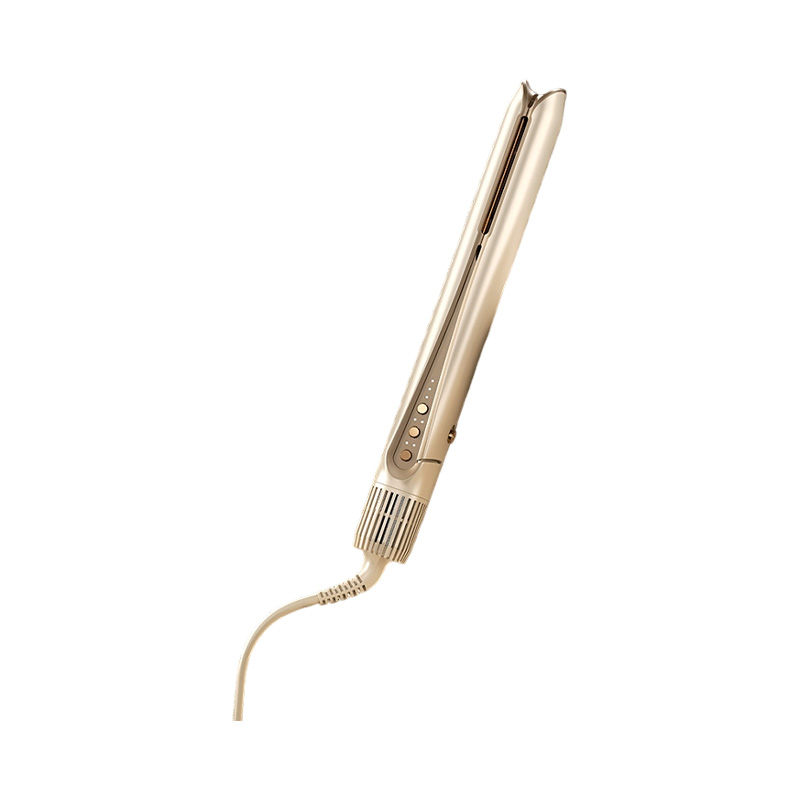 KH-810 Intelligent Temperature Control Straightener and Curling IronDual-function KH-810 straightener and curling iron offers intelligent temperature control and multiple heat settings, useful for alternating lower fringe and higher back styling.View Product →
Build direction and cool set into the pattern
Alternate the wrap direction on every other section to avoid a uniform pageant curl. For a face-framing effect, curl the front two sections away from the face on both sides. After each curl, cup it in your hand for 8 to 10 seconds while it cools. If your hair drops quickly, pin the cooled curl against the scalp with a metal clip and finish the rest of the head before removing the clips. A cool shot at the end helps set the cuticle, but it cannot rescue a section that was overheated. Keep the iron moving only during the wrap. Once the section is wrapped, leave it still.
Common mistakes and what to check before buying
- Clamping too much hair. The outer layer curls and the core stays flat. Use thinner sections instead of more heat.
- Raising the temperature to fix a short hold. If a section falls after two passes at 350 F, move to 375 F rather than 430 F.
- Skipping the cool set. A curl that is handled warm will drop before the end of the day.
- Using a dirty barrel. Product buildup causes drag and uneven heat transfer.
- Ignoring clamp tension. A loose clamp lets hair slip. An overly tight clamp leaves a hard crease.
Look for a temperature readout that stays within 10 F of the setting, a barrel coating that does not chip at the clamp edge, a swivel cord that does not pull the iron out of your hand, and an auto shutoff. For travel, check dual voltage before you pack it. A tool that jumps from 350 F to 420 F with no stable middle setting is a poor match for fine hair, even if the top temperature looks impressive.
A short practice routine
Set aside 20 minutes on dry hair. Start with the lowest temperature in the table and one side of the head. Curl four sections, wait 30 seconds, and check the pattern. If the curls are too tight, use a larger section or a shorter hold. If they fall, increase the temperature by 10 F. Once the first side is consistent, repeat the same section size and hold time on the other side. Write down the settings that worked. The next styling session becomes faster because you are repeating a measured process, not guessing.


 +86-574-63982198
 +86-574-63982197

 No. 933, Lingxu 2nd Road, Binhai Economic Development Zone, Cixi, Zhejiang, China.
