

 English
 中文简体
 Español

Content
You can curl your hair with a flat iron, and in most cases you can do it in under fifteen minutes. The result depends on three settings more than on the brand of the tool: the temperature you choose, the width of the section you clamp, and how far you rotate the iron before pulling it through.
A comfortable starting point is 180 C (355 F), a section about 2.5 cm (1 inch) wide, and a half rotation. From there you adjust one variable at a time. If the curl drops within an hour, the heat was too low or the section was too thick. If the hair comes out with a sharp crease, the iron was clamped at the ends or held too long in one spot.
One hardware detail matters throughout: the outer edge of the plate has to be rounded, not square. A rounded barrel lets the hair slide around the plate as you turn the iron, which is what creates the curve. A sharp edge simply folds the hair and leaves a visible line.
Before You Start: A Five Minute Setup
Good curls start with dry, fully detangled hair. Wet hair will steam, and steam is the fastest way to damage the cuticle. If you have just washed your hair, dry it completely first, either with a towel and air or with a dryer on medium heat.
- Heat protectant applied evenly from mid-length to ends, then combed through so there are no wet patches.
- Hair fully dry, with no leave-in product still sitting on the surface.
- A fine-tooth comb and two or three clips for sectioning.
- A straightener with plates around 25 mm (1 inch) wide; wider plates are faster on thick hair but produce looser bends.
- A heat mat or a safe resting surface, because the plates stay hot for several minutes after unplugging.
Give the protectant about a minute to settle before applying heat. Applying heat immediately after spraying can trap moisture and cause a small sizzle, which is a sign the hair is still damp rather than a sign the iron is working correctly.
If you dry and style in one sitting, a dryer with multiple attachments can handle rough drying and pre-styling before the iron comes out. A multi-attachment model such as the KH802A 18-in-1 multifunctional hair dryer is built around that sequence.
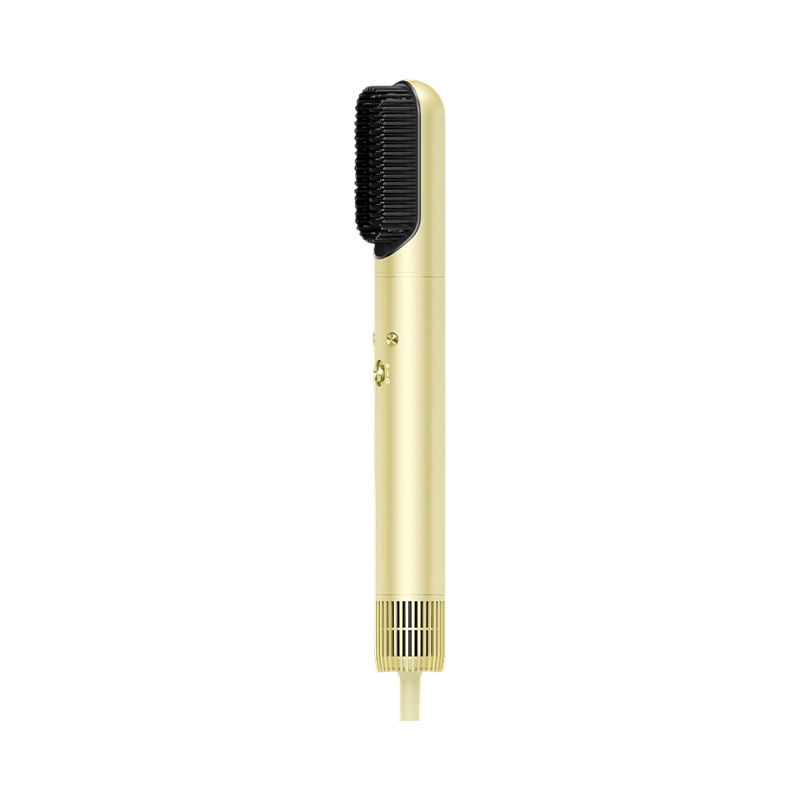 KH802A 18-in-1 Multifunctional Hair DryerAn 18-attachment hair dryer with multiple heat and speed settings, suited to drying and pre-styling before using a styling iron.View Product →
Step by Step: Clamp, Rotate, Pull
The sequence below works for shoulder-length and longer hair. For short hair, skip the band sectioning and work in smaller pieces around the face.
- Heat the iron to your starting temperature and let it hold there for a minute so the plates are evenly hot.
- Divide the hair into three horizontal bands: nape, middle, and crown. Clip the upper bands out of the way and start at the nape.
- Take a section about 2.5 cm wide and 1 cm thick. Comb it once so the strands lie flat.
- Clamp the iron about 2 to 3 cm from the ends, not at the very tips. Closing the plates on the ends is what produces the small crimp marks many people blame on the tool.
- Rotate the iron half a turn, either toward or away from your face. Keep the tension gentle; the hair should glide, not pull.
- Draw the iron down and out in one smooth motion, about 5 to 8 seconds per section. Do not stop halfway.
- Release the hair and hold the curl in your palm for a few seconds while it cools, or pin it loosely against the scalp.
One pass per section is enough at 180 C. A second pass on the same section adds shine for some hair types but also adds friction; if you need a third pass, the temperature is too low for that section.
Temperature Guide by Hair Type
Temperature is the variable most likely to be set too high. Thin, lightened hair can take a curve at 150 C, while thick resistant hair may need 200 C. Use the lowest setting that produces a curve that holds, and test on a small section at the nape first.
| Hair type | Starting temperature | What to watch |
|---|---|---|
| Fine, damaged, or color-treated | 120 to 150 C (250 to 300 F) | Shorter passes of 4 to 6 seconds; stop if the hair smells or feels brittle |
| Medium, normal, or wavy | 150 to 180 C (300 to 355 F) | Most curls hold at 170 C with a cool set |
| Thick, coarse, or resistant | 180 to 200 C (355 to 390 F) | Keep sections thin so the heat reaches the core of the strand |
| Coily or tightly textured | 180 C or lower, small sections | Comb through each section first; avoid over-clamping the same piece |
Matching the Rotation to the Curl
The same iron produces waves, classic curls, and tight ringlets. What changes is the rotation angle, the section size, and how fast you pull.
Loose waves
Use a 4 cm section, a quarter to half rotation, and a slow pull of about 8 seconds. Hold the iron almost horizontal and let the hair wrap only once around the plate.
Classic curls
Use a 2.5 cm section and a half rotation. Pull down and slightly outward, keeping the iron at about 45 degrees to the head. Alternate the rotation direction with each section so the curls blend instead of stacking.
Tight curls
Use a 1.5 cm section, a full 360 degree rotation, and a shorter pull of 5 seconds. Start closer to the root, but keep the iron moving so the heat does not concentrate in one spot.
Ends and face-framing bends
For a soft bend rather than a curl, clamp 5 cm from the ends, rotate a quarter turn, and pull straight down. This is the technique to use on the front pieces, where a full curl can look heavy.
Why Curls Fall Flat or Turn Out Crimped
Most disappointing results come from one of five habits. Fixing them usually improves the result more than buying a different iron.
- Clamping the very ends of the hair, which creates a sharp angle and a visible line.
- Working with sections that are too thick, so the inner strands never reach the plate.
- Moving the iron too fast at too low a temperature, which gives a bend that drops within minutes.
- Applying heavy oil or serum before styling, which coats the hair and reduces friction between the plate and the strand.
- Skipping the cool set, so the curl is stretched while the cuticle is still soft.
There is also a tool issue worth checking. Plates with a narrow, square edge and a wide gap between them are difficult to rotate smoothly; the hair catches and folds. Rounded edges and tight plate alignment make the motion feel predictable, especially on the second and third pass through a section.
Making Curls Last
Curls hold best when they cool in the shape you want. After releasing each section, cup the curl in your hand for 10 to 15 seconds, or pin it loosely with a clip and let it down after the whole head is finished. A blast of cool air from a dryer speeds this up.
Finishing products matter more than the amount. A light texture spray at the roots and a small amount of flexible hold spray at mid-length will keep the shape without weighing it down. Heavy creams applied at the root pull the curl out within an hour, particularly in humid weather.
At night, gather the hair loosely on top of the head with a soft scrunchie rather than brushing it out. Brushing separates the curl and turns a defined shape into frizz. In the morning, refresh the sections that have dropped with a few seconds of heat rather than re-curling the whole head.
What Matters in a Straightener Used for Curling
Almost any flat iron can make a curve, but a few specifications make the process faster and more consistent, especially if you curl your hair more than once a week.
- Plate width: 25 mm (1 inch) is the most flexible for curls; 38 mm (1.5 inch) suits long, thick hair and loose waves.
- Rounded outer barrel: the edge should let hair slide around the plate without a sharp fold.
- Temperature control in 5 to 10 C steps, with a displayed set temperature rather than a numbered dial.
- Heat-up time under 45 seconds, so the iron is ready before the sectioning is done.
- A swivel cord of at least 2 m and a cool tip, which reduce wrist strain when rotating the iron.
- Automatic shutoff after 30 to 60 minutes, a small feature that matters in a busy morning routine.
If you want one tool for both straightening and curling, a model such as the KH810 intelligent temperature control straightener and curling iron is designed around that dual role, with controlled heat and a body shaped for rotation.
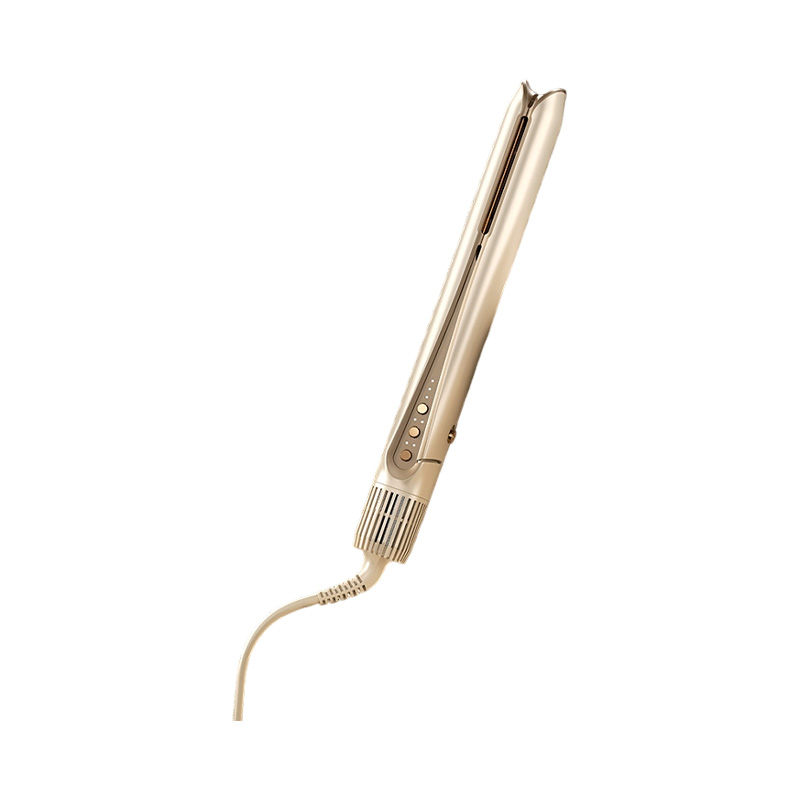 KH810 Intelligent Temperature Control Straightener and Curling IronA dual-function straightener and curling iron with intelligent temperature control, combining straightening and curling in one styling tool.View Product →
If you prefer to reduce the number of hot tools on the counter, this guide to multi-purpose styling tools explains how drying and shaping steps can share one device without compromising either result.
Start with one band at the nape and stop there if the curl holds. That single test tells you whether the temperature, section size, and rotation are right before you commit to the whole head. Most people need two or three attempts to find their numbers, and after that the motion becomes automatic.


 +86-574-63982198
 +86-574-63982197

 No. 933, Lingxu 2nd Road, Binhai Economic Development Zone, Cixi, Zhejiang, China.
